The Kavli Foundation, the WoodNext Foundation, and Partners Announce Inaugural Awards Supporting Instrumentation for Astrophysics
Collaborative awards will bring new technology to mid-sized observatories, accelerating discovery in planetary and stellar science.

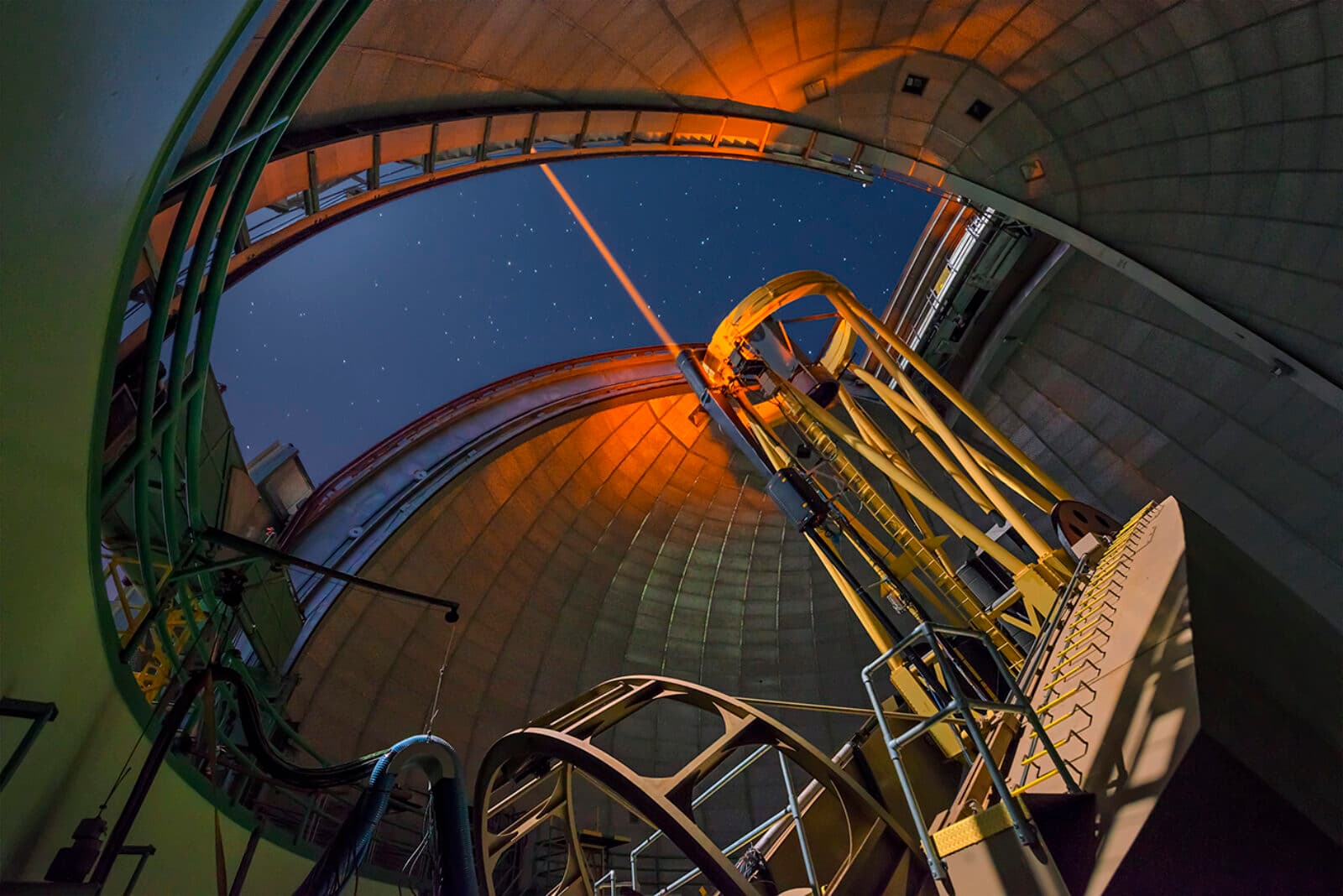
Credit: © UC Observatories/Laurie Hatch, Shane 3m
The Kavli Foundation and partners announce the recipients of awards to advance astrophysics by developing new instruments for mid-sized ground-based optical and near-infrared telescopes.
Two university-led projects will receive a combined $4.8 million in philanthropic support from The Kavli Foundation, the WoodNext Foundation, and philanthropist Kevin Wells, as part of Kavli’s Instrumentation for Astrophysics program.
By equipping proven observatories with next-generation instruments, the program seeks to extend the scientific reach of mid-sized (2-5 meter) telescopes, deliver new scientific insights, and demonstrate technologies that could be adopted by larger, flagship observatories.
“These grants reflect our ongoing commitment to advancing fundamental research in the field of astrophysics,” says Dr. Amy Bernard, Vice President of Science at The Kavli Foundation. “By supporting creation of novel technologies for existing observatories, we hope to open new research areas and mature technologies that will benefit the entire field.”
The program’s inaugural awards highlight this dual focus on innovation and impact with two major grants. A $3.7 million, four-year Kavli Exploration Award from The Kavli Foundation, in partnership with philanthropist Kevin Wells, will support Primary Investigator Dr. Pradip Gatkine (University of California, Los Angeles, Primary Investigator) and Dr. Kevin Bundy (University of California, Santa Cruz). This team will develop a novel astrophotonics instrument suite at Lick Observatory to study how planets form around nearby stars. The WoodNext Foundation, the philanthropy of Roku CEO/Founder Anthony Wood and his wife Susan, intends to make a $1.1-million, four-year award to support Dr. Daniel Jaffe (University of Texas at Austin) to construct an infrared polarimeter at McDonald Observatory. It will be used to explore stellar magnetic fields and their influence on planet formation. Each project demonstrates how novel instrumentation can enhance existing telescopes, opening new paths for discovery while leveraging existing platforms.
Astrophotonics comes of age at Lick Observatory
As a technology, photonics hearkens back to lasers and masers of the 1960s. Like electronic devices, which rely on electrons, photonic devices manipulate photons, which are particles of light. Arguably, the most prominent example of photonics occurs in telecommunications, where vast fiber-optic networks ferry data all over Earth.
Over the last 15 years or so, astrophotonics has sought to expand this core technology to improve astronomical observations. The photons involved in astrophotonics come from deep space, having traveled quadrillions upon quadrillions of miles before entering instrument fibers on Earth. Directing this cosmic light is significantly easier in astrophotonic equipment, reducing complexity and improving precision of astronomical instrumentation compared to conventional gear.
For the funded project, Gatkine, Bundy, and colleagues will be developing and testing an astrophotonic device designed to help reveal planets that would otherwise be hard to observe. The device will more effectively suppress the overwhelming light from stars that makes nearby planets harder to detect, a significant challenge for current research.
“The big-picture problem that we're trying to solve is how planets form,” says Gatkine, an assistant professor of physics and astronomy at UCLA. “We’re very excited to further develop astrophotonics as a potential game-changer for twenty-first century astronomical observation in this realm, along with other areas in astrophysics and cosmology.”
Demonstrating their device will help mature the technology for future instruments. Critically, astrophotonic devices can be made much smaller than conventional instruments. As an example, spectrographs, which scientists use to split light to learn about the distances and compositions of astrophysical objects, have had to scale in size and mass with the telescopes where they are installed. For the upcoming 30-meter-class telescopes, the spectrographs are slated to fill whole rooms.
“Some upcoming spectrographs are like the height of a giraffe, and their weight can be measured in elephants,” says Gatkine. “With astrophotonics, we can realize tremendous gains through miniaturization, boosting capabilities and cost effectiveness.”
The researchers will install their novel, compact astrophotonic instrument suite at the Shane 3-meter telescope at Lick Observatory, east of San Jose, California. Dr. Bruce Macintosh, the Director of the University of California Observatories that manages Lick, has long studied planet formation and looks forward to seeing how astrophotonic technologies will create new opportunities at mid-sized telescopes.
“Established, dependable, 2- to 5-meter telescopes have an important role to play in this modern era of astronomy,” says Macintosh. “This new Kavli-led instrumentation program is a great opportunity for the astronomical community to find innovative new ways to maximize the scientific return of these workhorse observatories."
“I am delighted to partner with The Kavli Foundation to support this outstanding research team, and grateful for the opportunity to be a partner in the in-depth process that resulted in this innovative project,” adds Wells. “In addition to advancing the science of exoplanet formation, this project is a wonderful demonstration of the enduring power of older telescopes to be retrofitted with advanced technology and thereby continue to advance the field of astrophysics.”
Zeroing in on magnetic fields at McDonald Observatory
The second instrument supported by the program, a specialized infrared polarimeter, will measure the polarization of light from red dwarfs, the most numerous stars in the universe. Researchers want to learn more about these cool, crimson stars’ magnetic activity and assess whether their planets could be habitable. By studying gestating stars and solar systems as well, the polarimeter will complement the astrophotonics instrument in getting to the root of long-standing mysteries about planet formation.
The new polarimeter will be several times more sensitive than current equipment in detecting magnetic fields, unlocking new observational space. Magnetic fields are known to partly dissipate the planet-forming disks that encircle most newborn stars, yet the mechanisms and timing are poorly understood. Magnetic fields can also inflate fledgling stars’ atmospheres, making them appear younger and confounding models of solar system development. The project also includes innovative data-taking and analysis software for evaluating instrument tests.
WoodNext’s support for this project reflects the foundation’s broader mission to advance human progress. “The polarimeter project we’re supporting at McDonald Observatory stands to significantly move scientific understanding of small stars’ magnetic fields forward and bring new observational capabilities to the fore,” says Nancy Chan, WoodNext’s Executive Director. “We’re proud to join in this partnership spearheaded by The Kavli Foundation.”
Guided by input from leading scientists and enhanced by participation from partner funders, Kavli’s Instrumentation for Astrophysics program reflects its targeted approach to advancing science by investing where innovation can have a broad, lasting impact.
“These projects demonstrate the power of philanthropic partnerships to accelerate progress towards shared, impactful scientific goals,” says Dr. Cynthia Friend, President and CEO of The Kavli Foundation. “Through this collaborative approach, we can develop tools and technologies that expand what’s possible in astrophysics - and across science broadly."