When scientific side quests are given a chance
by Rachel Tompa
The Kavli-Grass fellowship program, now in its fifth year, enables outside-the-box thinking on neurobiology and changing ecosystems.

The Author

One research project investigated reproduction in a newly discovered worm species. Another was the first to explore a marine invertebrate’s hearing limits. The scientists carried out each one beyond the walls of their regular laboratories as part of a special summer program that gives researchers the chance to explore how environmental stressors impact animals’ nervous systems.
For 14 weeks, Kavli-Grass Fellows pursue unconventional projects at the intersection of neuroscience and ecosystem changes in bucolic Woods Hole, Massachusetts, at the Marine Biological Laboratory, a research institute renowned for its expertise and infrastructure in neuroscience and marine science. Since 1951, The Grass Fellowship Program has offered early-career scientists the freedom and resources to pursue their own research questions.
Since 2022, the Grass Foundation has partnered with The Kavli Foundation to support a subset of fellows pursuing unconventional projects at the intersection of neuroscience and changing ecosystems. The partnership is part of Kavli’s Neurobiology and Changing Ecosystems Initiative, which advances research into how environmental change affects nervous systems and behavior.
Now in its fifth year, the program has supported 11 scientists. The 2026 Kavli-Grass Fellow, Gabrielle Bostwick, just wrapped up a project exploring how bobtail squid use neural circuits in their arms to respond to chemical and mechanical cues during prey capture, and how those responses shift when the pH or salinity of their marine environment changes.
For many fellows, these summer projects are scientific detours from their day-to-day work, — a chance to pursue an intriguing question that wouldn’t otherwise be possible. But a detour can lead to unexpected places. For some, the Kavli-Grass Fellowship has opened a new research direction, while for others, it has had implications beyond the laboratory.
“This project was not my main postdoctoral project,” says James Lee, a postdoctoral research fellow at The Rockefeller University and a 2023 Kavli-Grass Fellow. “It was a dream that I had on the side.”
A worm built for extremes
Lee’s project began in California’s Mono Lake, a wild and alien-looking landscape with high salinity, high pH and extraordinary concentrations of other chemicals like arsenic, a potent neurotoxin. One of the oldest lakes in North America, Mono Lake is surrounded by white, jutting stone formations known as tufa towers, formed as calcium carbonate precipitates out of the water.
Until recently, scientists thought only two animal species occupied these strange waters: brine shrimp and alkali flies.
“You get there and you can immediately tell how desolate it is. Aside from some migrating birds, you look around and there are no fish, no amphibians, no mammals,” Lee said. “But there are tons of the alkali flies forming swarms on the lakeshore. That adds to the feeling of quite an extreme environment.”

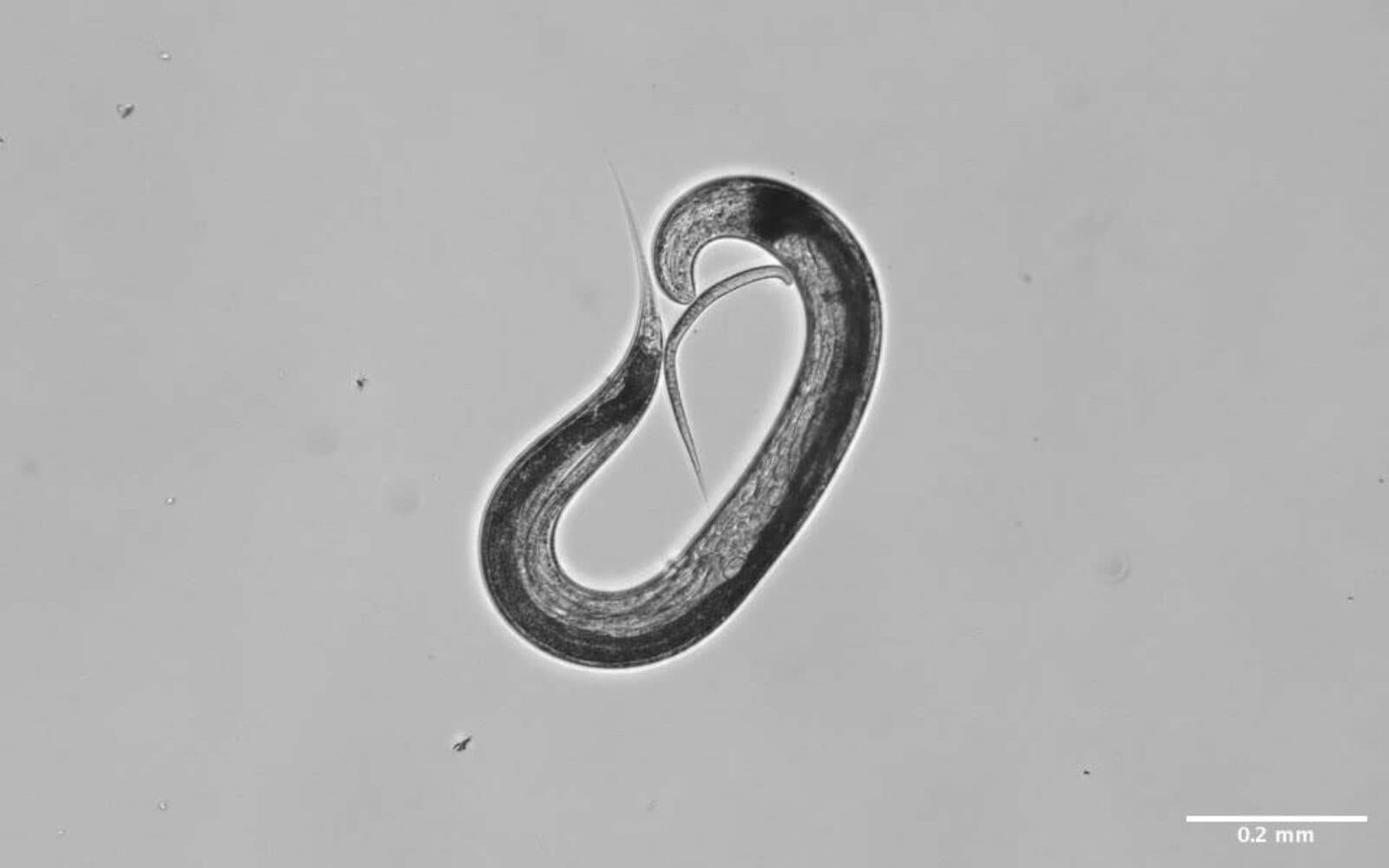
At the time, Lee was working as a doctoral student at the California Institute of Technology in Paul Sternberg’s laboratory. Sternberg and his lab mates suspected that shrimp and flies were not the only organisms at Mono Lake and from its shores identified eight species of nematodes, or roundworms, including five never-before-seen species. One of those species, dubbed Tokorhabditis tufae after the lake’s towers, formed the basis for Lee’s Kavli-Grass Fellowship project.
In lab tests, the scientists found that T. tufae can survive 150 times the arsenic concentration that would kill human cells. The little worm is unusual in another way too: Unlike most other nematode species, which lay eggs, T. tufae gives birth to live young. Lee wanted to know how T. tufae withstands Mono Lake’s extreme ecosystem, particularly the arsenic levels.
Although he had already started a postdoctoral fellowship studying a different nematode, C. elegans, in Cori Bargmann’s lab at Rockefeller, Lee returned to T. tufae during his Kavli-Grass fellowship to study the connection between the worm’s arsenic tolerance and live birth.
At Marine Biological Laboratory, Lee found that the worm protects its young from arsenic poisoning by incubating them until they are old enough to develop resistance. When he removed the young from their mother earlier than they would naturally be born, the animals died in high arsenic conditions, even though they thrived under regular laboratory conditions. He also discovered that the worm’s neuronal control of live birth is very different from the neural systems that other nematodes use to lay eggs. T. tufae young are active participants in their birth, flexing and pushing themselves out of the birth canal, he found.
The ultimate goal of his work, and of other “extremophile” research, was to understand how different organisms adapt to environmental challenges, Lee says. As a result of the fellowship, Lee has shifted his postdoctoral research to focus solely on T. tufae and how the worm develops arsenic resistance. He’s aiming to launch his own research laboratory focused on this tiny, remarkable worm.
“Because of things like pollution and agriculture and mining, we’re increasingly facing a world with chemically extreme environments,” Lee said. “Studying these worms can help us learn about how biology can adapt to chemical stress.”
A squid’s soundscape
When you’re out in a boat, it might not occur to you to think about the effects of your activity on tiny underwater denizens. But boat noise can have a big impact on small creatures. 2022 Kavli-Grass Fellow Rosalyn Seddon spent her summer studying how underwater noise might damage the hearing of the little cephalopods known as bobtail squid.
“There’s a lot of focus on marine mammals and fishes for the effects of noise on aquatic life, but that isn’t all of the ecosystem. We have to think about invertebrates as well,” Seddon said.
At the time she applied for the fellowship, Seddon was a postdoctoral fellow at the University of Minnesota Duluth studying the effects of underwater noise on freshwater fish. But the two-inch-long bobtail squid intrigued her, as did the dearth of information about how these tiny animals hear and how human noises might influence them.
To test the squids’ hearing, Seddon exposed them to different frequencies and intensities of noises designed to mimic boat noise and measured their responses using electrical readouts. She found that squid respond most strongly to sounds in the 300 to 500 Hertz range, right in the middle of the low-frequency noise range that most boats emit. She also found that boat noise at typical intensities damages squid hearing — after 15 minutes of exposure, the animals stopped responding to the same sound, indicating they could no longer hear it as well.
“It’s like when you go to a concert and you get this ringing in your ears afterward. Hopefully it goes away by the next day,” Seddon said. The squids’ hearing recovered within a few hours, but with continuous exposure, the loss could become permanent, she adds.
Now a senior scientist at the Centre for Fisheries, Environment and Aquaculture Science in the United Kingdom, Seddon works on underwater noise and commercial boat use policies. Her research has fed into guidance the Centre is developing around noise regulation and marine invertebrates.
“The Kavli-Grass fellowship supports research at the organismal level, down to the neurons. If we have that basic science where we see how exposures affect these species, it all builds knowledge that we can use in policy and management,” she said.
Five years into the Kavli-Grass partnership, the fellowship continues to give early-career researchers the freedom to follow unconventional questions wherever they lead. From arsenic-tolerant worms to bobtail squid’s hearing and neural circuits, the fellows’ work shows how environmental stressors provide opportunities for discovery, revealing biology that might otherwise remain hidden.
Meet More Kavli-Grass Fellows
Explore the research of other Kavli-Grass Fellows working at the intersection of neuroscience and changing ecosystems.
Christian Hoffmann, German Center for Neurodegenerative Diseases | 2025 Kavli-Grass Fellow
Hoffmann developed new ways to study how environmental conditions affect sea slugs’ behavior and nervous system.
Kyra Shapiro, Brandeis University | 2025 Kavli-Grass Fellow
Shapiro explored how the nervous system helps mollusks build and pattern their shells — and how environmental conditions may alter that process.